
Beyond the Prompt Box: How Generative Diffusion Is Infiltrating Virtual Production and Real-Time 3D
Typing a paragraph into a chat box was only the prologue. The true revolution in cinematic generative AI is happening inside game engines and LED volume soundstages through real-time spatial conditioning.
For the past three years, the public conversation surrounding generative video has been obsessed with text prompts. Type a poetic description into a chat interface, wait sixty seconds, and watch a standalone video file emerge. But inside professional film stages, virtual production volumes, and game development studios, text-to-video is increasingly viewed as an evolutionary dead end.
Cinematography is not a literary medium; it is a spatial one.
Directors and directors of photography do not think in adjectives—they think in focal lengths, lighting ratios, camera tracking telemetry, parallax, and depth planes. Asking a generative model to guess the exact three-dimensional coordinates of a scene purely from prose will always yield unpredictable physics, drifting geometry, and impossible lighting continuity.
The real breakthrough in cinematic AI is taking place where generative diffusion meets real-time 3D game engines like Unreal Engine 5.
Spatial Conditioning: Replacing Words with Geometry
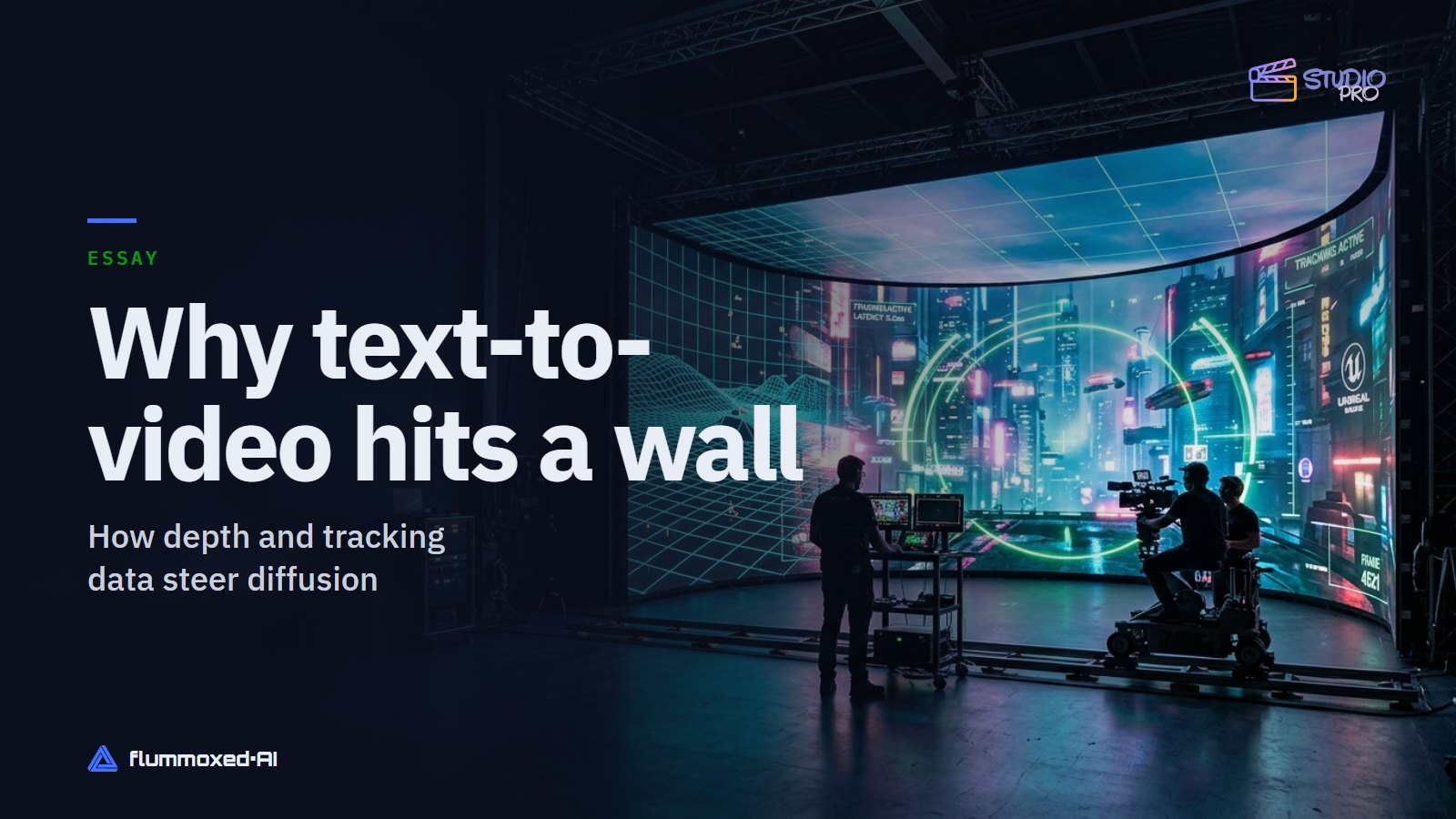
The critical leap forward is spatial conditioning. Instead of prompting a model from scratch, production pipelines supply diffusion models with structural ground truth: depth buffers, surface normal maps, optical flow vectors, and camera tracking metadata extracted directly from real-time 3D viewports.
When a diffusion model is conditioned on geometric data: * Camera tracking is absolute: The camera can dolly, crane, or whip-pan through a virtual set with mathematically flawless parallax. * Lighting reacts dynamically: Physical on-set lights can be synchronized with digital key lights inside Unreal Engine, with diffusion passes rendering photorealistic bounce lighting in real time. * Actor integration is seamless: Live-action talent on an LED volume stage is enveloped by responsive background plates that shift in real time with the camera's optical axis.
The Convergence of 3D Gaussian Splatting and Generative Video
A parallel revolution is unfolding in location scouting and set construction through 3D Gaussian Splatting (3DGS) and Neural Radiance Fields (NeRFs).
Traditionally, building photorealistic digital environments for virtual production required months of manual 3D modeling, texturing, and optimization by large VFX teams. Today, a location scout can walk through an abandoned warehouse or an ancient desert canyon with a camera rig, capture video footage, and reconstruct an editable, high-resolution 3D Gaussian splat in under thirty minutes.
Generative diffusion is then applied on top of this captured spatial geometry to: 1. Re-light the environment to match any time of day or atmospheric condition. 2. Introduce dynamic weather effects—such as torrential rain, blizzard snow, or volumetric sandstorms—that interact accurately with physical surfaces. 3. Populate expansive background plates with animated crowds and ambient traffic.
By anchoring generative models to real-world geometric scans, filmmakers achieve photorealistic fidelity without sacrificing spatial coherence.
Democratizing the Million-Dollar Soundstage
Until recently, LED volume production—made famous by productions like The Mandalorian—was restricted to nine-figure Hollywood blockbusters due to the immense cost of designing and rendering real-time virtual sets.
The integration of generative diffusion with real-time engines is dramatically collapsing these barriers. Independent filmmakers and boutique production houses can now achieve multimillion-dollar visual production values on modest green screens or compact LED stages, using generative models to synthesize high-fidelity set extensions, crowd simulations, and atmospheric VFX in fractions of the traditional post-production timeline.
The Director's New Canvas
We are witnessing the death of the generic prompt box and the birth of the spatial AI canvas.
Generative AI is not replacing the director's vision; it is eliminating the technical friction between imagination and execution. By fusing the spatial precision of 3D game engines with the limitless textural imagination of diffusion models, the future of cinema is becoming faster, more accessible, and profoundly more creative.