
Why we called it Flummoxed
We chose "Flummoxed" not only for its historical context, but also for the weight it carries as a shared human reaction to AI. We're all "perplexed, confused, bewildered and feeling defeated." In our work, being flummoxed reminds us to stop and reflect on our mission: “Unlocking Human Potential with AI.”
Historical Context
In May 1997, two newspapers used the same word when Deep Blue defeated Garry Kasparov, and that word has appeared in many more media milestones since.


“Deep Blue’s play took on almost human proportions as he flummoxed Kasparov.”

“Would so flummox the champion that he questioned its very soul.”
The result mattered because chess had been made to carry so much of our idea of intelligence. The machine did not merely win points. At moments, it appeared to exercise the positional judgment people believed distinguished a grandmaster from a calculator. Garry Kasparov was not simply a very good player. He was the world champion, a grandmaster standing at the edge of what memory, intuition, calculation and nerve could accomplish together. Deep Blue beat him, and humanity got a glimpse into the future.

Deep Blue was not a frontier model as we know them today. It was a specialized chess machine, exceptionally powerful within a defined domain. But Kasparov was playing against a glimpse of the future we now inhabit: a system whose output could be competent, consequential and difficult even for the expert across the table to explain. It was a wonderful and extremely human move,
Kasparov wrote. I could feel—I could smell—a new kind of intelligence across the table.
The earliest contemporaneous use of flummoxed our research has verified appears in The Irish Times on May 17, 1997. Its description is striking: Deep Blue’s play took on “almost human proportions” as it flummoxed Kasparov. On May 18, The New York Times reported that IBM had taught Deep Blue techniques that would “so flummox the champion that he questioned its very soul.”
And the term stuck, appearing again in a TIME article about the match.
Another time and another match
AlphaGo was an AI system created by DeepMind, the AI research lab that had joined Google in 2014. DeepMind was the team; AlphaGo was the system it built. The team wanted to see whether neural networks, reinforcement learning, and search could learn Go patterns well enough to master a game that had resisted computers for decades. AlphaGo’s 5–0 victory over European champion Fan Hui in October 2015 was the first time a computer had defeated a professional player at full-sized Go without a handicap. But Lee Sedol represented another order of challenge: the winner of 18 world titles and widely considered the greatest Go player of the preceding decade.
DeepMind arranged a public five-game challenge match between AlphaGo and Lee in Seoul in March 2016. The purpose was direct and consequential: to test whether the system could defeat elite human intuition in a game still treated as one of AI’s great unsolved challenges. The match put AlphaGo across the board from one of the few people qualified to show where machine competence ended and distinctly human judgment began.
Go mattered because it was supposed to be different. Its possible positions were too numerous for the brute-force computation people associated with computer chess, and its best play seemed to depend on patterns, balance, and intuition that were hard to reduce to explicit rules. If Deep Blue had conquered calculation, Go still looked like shelter for a more elusive kind of human judgment.
AlphaGo won the opening game, so it entered Game Two of the five-game series leading Lee 1–0. That was the state of the encounter when Lee stepped away from the table for a cigarette break after playing Move 36. While he was outside, AlphaGo placed a black stone high on the fifth line: Move 37. It violated established Go wisdom so sharply that professional commentators initially thought it might be an error. AlphaGo’s policy network estimated that a professional human would choose the move only once in ten thousand attempts. The move proved pivotal, and AlphaGo won Game Two to take a 2–0 series lead.

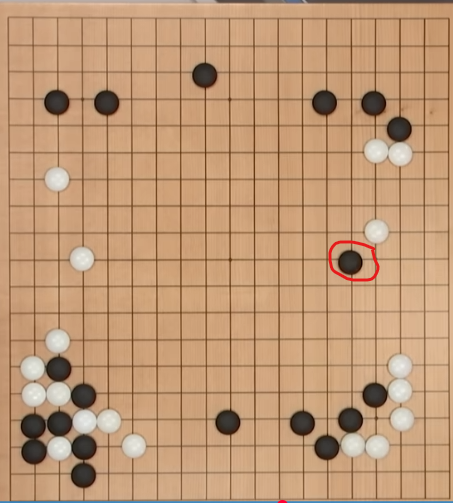
Lee returns to the board and sees Move 37.
Lee returned, saw the stone and stopped. In the footage from that moment, he had seemed almost robotic throughout the game, but not after Move 37. His reaction is very human: shock in the furrow of his brow, then a smirk of pride, then more than 15 minutes flummoxed as his mind worked to bring a move outside human convention back into comprehension.
WIRED wrote that the move “flummoxed even the world’s best Go players, including Lee Sedol.” After the game, Lee called it creative. AlphaGo had not simply found a move a human had missed. It produced one that forced humans to reconsider what originality could look like when it came from a machine.
The term stuck yet again. In May 2017, after AlphaGo defeated Ke Jie, The Guardian made it the headline: “World’s best Go player flummoxed by Google’s ‘godlike’ AlphaGo AI.” What had surrounded Deep Blue in 1997 returned around the next game, which people believed would protect a distinctly human form of intelligence.
Outside the game
Deep Blue and AlphaGo were narrow systems in today’s context of frontier models. But the direction of travel is no longer confined to chess squares and Go stones. Machines now write, reason, code, translate, diagnose, design and participate in scientific discovery. Their competence is uneven, and their failures matter, but the challenge they pose to old assumptions about human intelligence has widened.
That is why we take the history seriously. Kasparov and Lee were not ordinary proxies for humanity. Within the forms of intelligence their games demand, they represented something closer to a pinnacle of human potential. They sat across from systems building toward an unknown future, one that is now apparent, both frightening and exciting.
The question underneath the current pursuit of AGI is larger than whether a model can pass another benchmark. It is what happens to our institutions, our work and our understanding of ourselves as abilities we treated as proof of human exception become reproducible by machines. The chessboard gave us an early, contained view of that pressure. We are living with its broader version now.
Why Flummoxed
Rooted in the historical milestones of AI’s development, Flummoxed reflects a human response to an uncertain future. Kasparov and Sedol represented the best of us in games that reflect humanity’s intellectual pinnacle: concentration, knowledge, expertise, strategy, and the power of predicting an opponent’s next move—in this case, a machine’s. In these early examples, we learned that the machine can outwit us in a way that is not only superior, but can appear remarkably human. Kasparov and Sedol’s reactions in those moments were more human than anything the machines across from them could express. Their being flummoxed reflects a state only a person possesses: presence in a moment, where emotion, thought and physiology register instantaneously and all at once.
The earliest definition we found is unusually appropriate: “to perplex, bring to confusion, bewilder, defeat.” Online Etymology Dictionary The context in which the word has appeared throughout AI's history is profoundly appropriate for our humanity now.
We chose Flummoxed not only for its very human definition and historical context, but also for the weight it carries as a shared human reaction to AI. We’re all perplexed, confused, bewildered and feeling defeated. But we do not have to face this alone. We are in it together, and we are all flummoxed to one degree or another.
The name lets us hold two things at once: the gravity of what is changing and the humanity we share that lets us remain recognizably human as we face it. In our work, being flummoxed reminds us to stop and reflect on our mission:
Unlocking Human Potential with AI.Sources
- The Irish Times, “Success can be lonely with no mate to check”
- The New York Times, “What Deep Blue Learned From Grandmasters” (archived course copy)
- Garry Kasparov in TIME, “The Day That I Sensed a New Kind of Intelligence”
- TIME, “Did Deep Blue Beat Kasparov Because of a System Glitch?”
- Google DeepMind, “AlphaGo”
- WIRED, “In Two Moves, AlphaGo and Lee Sedol Redefined the Future”
- The Guardian, “World’s best Go player flummoxed by Google’s ‘godlike’ AlphaGo AI”
- Online Etymology Dictionary, “flummox”