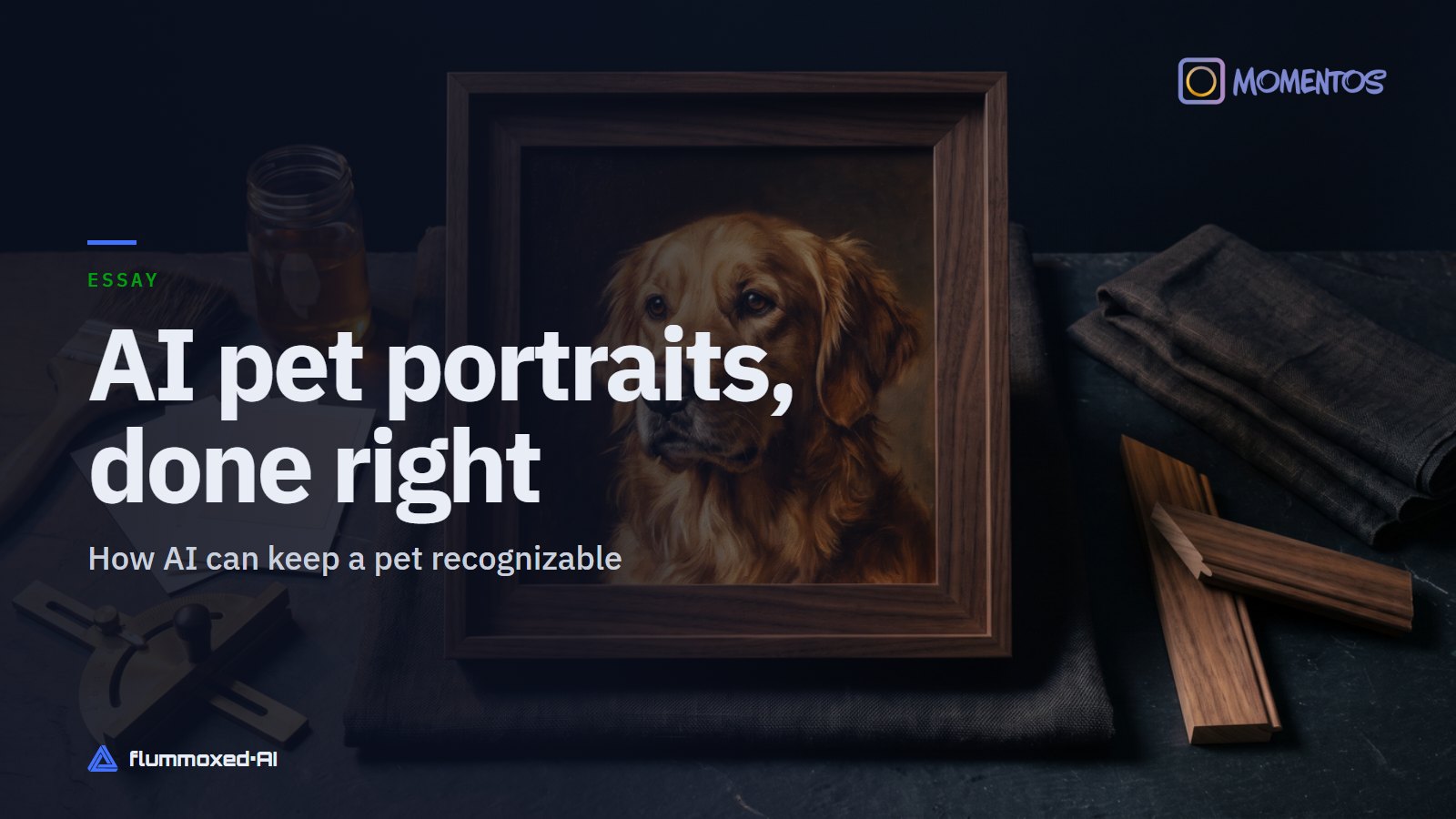

The Modern Pet Portrait: Moving Beyond Gimmicky AI Filters to Authentic Keepsakes
Why early AI pet apps produced disposable cartoon novelties, and how spatial diffusion, identity conditioning, and archival print aesthetics are transforming the 'Gotcha Day' celebration into heirloom-grade photographic art.
Every pet owner remembers the exact day everything changed.
For many of the 4.2 million shelter animals adopted in the US in 2025 alone, a biological birthdate is simply unknown. In its place, a far more meaningful emotional milestone has emerged: "Gotcha Day"—the annual anniversary of the day an animal was brought home from the shelter, welcomed through the front door, and adopted into the family.
Borrowed from adoptive families, Gotcha Day has become a fixture of rescue culture. Every adoption is a new anniversary, and owners look for ways to honor the date, celebrate their animal’s companionship, and commemorate the bond they share.
Yet when generative artificial intelligence first arrived in consumer photography, the market responded with an avalanche of aesthetic insults.
A wave of mobile apps launched with a single, cynical premise: upload a batch of photos of your golden retriever, and their cloud model will paste your dog's head onto a medieval knight in armor, render them as an astronaut floating in orbit, or turn them into a hyper-saturated Disney Pixar cartoon.
For twenty-four hours, the novelty was amusing. Users shared the images on Instagram, laughed with coworkers, and never opened the app again.
The novelty died because cartoon gimmickry fundamentally misunderstands the emotional core of pet ownership.
Pet owners do not love an abstract archetype of a dog; they love their dog. They love the asymmetrical white blaze down their snout, the slight notch in their left ear from their shelter days, the soulful amber flecks in their eyes, and the specific, dignified posture they hold when watching the front door.
When generative AI erases those idiosyncrasies behind a plastic, generic filter, it destroys the very soul of the portrait.
In 2026, a profound creative shift is underway. By marrying spatial identity conditioning with classical fine-art studio lighting and archival physical print standards, creators are turning generative diffusion into an instrument of genuine preservation: the modern photographic keepsake.
1. Why Early AI Pet Art Failed: The Identity Collapse Problem
Why did early generative diffusion models perform so poorly with animals?
When standard foundation models (such as base Stable Diffusion, Midjourney, or DALL-E) are prompted with "a portrait of my dog," they do not possess a concept of that specific animal. They sample from the statistical centroid of millions of scraped dog pictures.
The resulting outputs suffer from three structural defects:
1. Homogenization of Breed Nuance
A rescue mutt with a shepherd mix, hound ears, and a boxer jaw is averaged into a generic, clean-cut lab-cross. The model strips away the very irregularities that make the animal recognizable.
2. Anatomical Distortion
Animals do not pose like human models. Diffusion models frequently misinterpret paws, dewclaws, whiskers, and ear folds, generating sixth toes, fused claws, or eerie plastic specular highlights across the fur.
3. The Uncanny Valley of Cartoonification
To mask anatomical errors, early apps applied cartoon rendering styles. But while a cartoon is cute for a ten-year-old child's sticker book, it is insulting to an adult seeking to memorialize a senior dog nearing the end of its life, or to celebrate a decade of faithful companionship.
2. The Technical Frontier: Multi-Stage Spatial Identity Conditioning
The breakthrough that unlocked the modern photographic keepsake is multi-stage spatial identity conditioning.
Rather than relying on vague text prompts, the better creative engines build a staged pipeline that separates identity from aesthetic style:
- Step 1: Feature Extraction & Anchoring: The user uploads a single, ordinary, unpolished phone snapshot. The engine extracts the invariant geometric anchors of the animal: skull structure, muzzle length, ear stance, coat color distributions, and distinguishing marks.
- Step 2: Spatial Control Mapping: Using depth-conditioned guidance (such as depth ControlNets and image-prompt adapters like IP-Adapter), the model locks the animal's physical posture into natural, dignified poses: alert sitting, relaxed recumbency, or noble head-turn.
- Step 3: Classical Optical Rendering: Rather than flattening the animal into cartoon graphics, the model places the locked animal into real photographic light: natural north-facing window light, moody charcoal studio drapery, or soft outdoor golden hour illumination.
- Step 4: Archival Print Conforming: The raw latent generation is passed through high-fidelity neural upscalers (such as SUPIR or CCSR) to recover fur and whisker detail at print resolution, soft-proofed against the paper profile of fine-art cotton rag.
3. The Psychology of the Keepsake: From Social Feed to Living Room
There is a fundamental psychological divide between digital media consumption and physical keepsake ownership.
A digital image viewed on an iPhone screen is ephemeral. It competes for attention against push notifications, news headlines, and endless social feeds. It has no weight, no permanence, and no physical presence.
A framed physical portrait hanging above a fireplace or sitting on a work desk operates in a completely different psychological register: * A Daily Presence: It becomes part of the physical architecture of the home. Family members pass it every morning. * A Marker of Life Transitions: For a newly adopted rescue pet, it commemorates their transition into safety on Gotcha Day. For a pet that has passed away, it serves as a dignified memorial that celebrates their life without dwelling on grief. * A Statement of Family Membership: For 97% of U.S. pet owners, pets are part of the family. Commissioning a bespoke, fine-art portrait is an act of honoring that familial status.
4. The Market Opportunity: The "Doorway Next Door"
Search a generic phrase like "photo gift ideas" and the first page belongs to national retailers such as Amazon, Etsy, and Target.
The occasion itself is a different matter. Gotcha Day is a moment the big gift aisles were never built around—and with 4.2 million shelter adoptions a year in the US, that is millions of new anniversaries every year.
National retailers sell mugs and canvas wraps printed from whatever photo you upload. Novelty AI apps sell cartoon stickers.
The market has left an enormous, high-intent opening for studio-grade, identity-locked photographic keepsakes.
Summary: What Defines the Modern Pet Keepsake?
The transition of AI pet art from disposable novelty to fine-art keepsake is defined by three fundamental principles:
- Identity Preservation: Using spatial conditioning and feature extraction to lock the true physical markings, ear shapes, and eye color of the specific animal.
- Timeless Aesthetic Dignity: Abandoning identity-erasing filters and oversaturated cartoon rendering in favor of real photographic light and authentic composition.
- Archival Physical Reality: Engineering for 300 DPI fine-art giclée prints and physical framing that celebrate adoption milestones and lifelong family companionship.